
The biggest news of the summer for the Habs was definitely the departure of their captain Max Pacioretty towards Las Vegas. The acquisition of young Jesperi Kotkaniemi in the last draft has been much talked about, but it is undoubtedly the fate of the American winger now a member of Golden Knights that has made the most noise, and with good reason. He was not the first player wearing the « C » for the CH to be traded, and will surely not be the last.
One of the two centerpieces obtained in return is young forward Nick Suzuki. I believe the return obtained for the one nicknamed « Wolverine » is more than satisfactory, especially taking into account the context of the trade, and the young Owen Sound Attack center plays a big part in this.
Drafted in 2017, he has been one of the most productive and spectacular players in the Canadian Hockey League for the last two seasons and is a highly promising prospect with a top offensive talent. This is a player who definitely has first-line potential and has a full offensive arsenal to his disposal, both capable of scoring and of creating chances for his linemates.
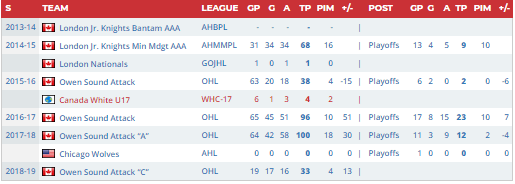

Standing 5’11 » tall, Suzuki is a player who can do everything in the offensive zone. He is just as dangerous when he decides to shoot on net as when he tries to prepare chances for his teammates. His main assets are undoubtedly his creativityand his hockey sense. This makes him capable of creating offense from any situation and he knows how to be a sparkplug for his team offensively, having earned 31 points more than his teams’s 2nd best scorer in 2017-2018.
When it comes to scoring goals, Suzuki possesses two important assets: his wrist shot and his hands. He can releases his shot without warning and with surgical precision. It is very difficult to read his intentions for his opponents and he regularly surprises the goalkeepers with shots from far. Given his constant ability to make passes through the oppositon’s coverage, opposing goalies cannot cheat towards him to cut his shooting angles or Suzuki will make them pay by making a pass to an open teammate instead.
In addition to his creativity, he has very fast and precise hands and an impressive arsenal of moves. If he is not an ultra fast skater, he is able to beat opposing defenders with fakes, direction changes, speed changes as well as with his fast execution with the puck. Just watch a few minutes of his highlights to see his great talent.
This year, many expected him to play several games throughout the Canadiens’ training camp as the Habs were undoubtedly looking for help at center. However, the emergence of young Jesperi Kotkaniemi caused him to be somewhat sidelined, which may not be a bad thing for his development.
Some may see a bad sign in seeing this talented player, drafted in the top 15, still in the juniors two years after his draft. Nowadays, we are used to seeing talented young players break into the NHL faster and faster. However, three names from the 2015 Draft come to mind for me: Matthew Barzal, Thomas Chabot and Dylan Strome. These three players have indeed spent the two seasons following their draft year with their junior teams, which in no way diminished their status as top prospects.
Moreover, we can note in the cases of Chabot and Barzal that they were able to take advantage of their prolonged stays in the juniors to gain confidence by dominating the competition and to perfect their game so as to be able to have an impact right away in their NHL rookie seasons. Barzal had a stellar first season of 22 goals and 85 points, while Chabot had nine goals and 25 points in 63 games. The young Senators defenseman currently has 22 points in 18 games in his second season; I would like to see Suzuki seize this opportunity to do the same. So far, he has 17 goals and 33 points in 19 games to his record this year, an excellent start to the season.
We therefore have to expect great offensive performances from this young player if his development goes as planned. His draft season of 45 goals and 96 points in 65 games is extremely impressive; in comparison, Alex Galchenyuk had a total of 31 goals and 83 points in his draft year. These figures can also be compared very favorably to those of a player like Filip Zadina, who finished last season with 44 goals and 82 points in 57 games before being drafted 6th overall in the summer.
Interestingly enough, although he is a natural center, he has in recent seasons shared the role of center on his trio with his faithful linemate Kevin Hancock. These two players are very accustomed to the center position and complement each other admirably no matter which of the two moves to the wing and their coaches take advantage of this to change their positions as needed, according to the strategic needs they identify during the season. They shared the face-offs in a more or less even proportion and also alternated in their defensive responsibilities.
This should not be interpreted as a disavowal of his work at center, but rather as a proof of his versatility and hockey sense. He also receives praise for his great constancy and his passion at work, he who shows up day in, day out and rarely has an off-game. He is also an extremely disciplined player, as evidenced by his derisory penalty totals (18 minutes in 2017-2018, 10 minutes in 2016-2017).
Moreover, when one asks Suzuki what kind of player he aspires to be, he does not speak only of his offensive contribution. He is a player who attaches great importance to being efficient at both ends of the ice and shows great dedication towards his defensive play. He is very hard-working and is not a strictly offensive player who will hurt his team with risky plays. I have no doubt that he will do all the work necessary to be able to do well at the professional level in that regard.
Suzuki seems a rather complete player, but what flaws can we identify in his game? As with any player of smaller stature, he will never be the kind of player to beat his opponents with brute strength or to run them through the boards on a regular basis. He will have to make sure to gain a few more pounds and to gain strength by next season.
His skating is excellent agility-wise, but it can be said that his top speed and acceleration are not anywhere close to the elite level of his puck handling and hockey sense. If he could improve this element by a level or two, he would be even more of a threat and more effective on the ice, because this would perfectly complement his style of play, he who relies on quick execution on the ice.
I think his ability to score goals in the NHL will be slightly lower than in the junior ranks. He has an excellent wrist shot that should allow him to score many goals, however many of his goals were scored after he was able to beat the defenders and / or the opposing goalkeepers with spectacular moves which will have much less chances of working against pros. His ability to pass will be that much more important as it will ensure that the opposing defenders will respect his talent as a playmaker, opening shooting lanes for him.
Suzuki is headed for a 50-goal, 110-point season so far, and it would be surprising if he slowed down much. I hope to see the Owen Sound Attack play several playoff rounds, and they are currently 5th in the OHL with 12 wins and 26 points in 21 games. He should be knocking hard at the NHL’s door next year, and even though a start in the AHL would not be dramatic, I expect to see him in the NHL very soon. It will be up to him to adapt to the speed of play and learn to exploit his great talent to the fullest once that happens!
If you have any player to suggest for an analysis, feel free to leave a comment below!
I leave you with this video of a nice little goal scored by Suzuki, last Saturday against the Erie Otters. Not bad!
 Le Dépisteur